


Veeam Backup & Replication Security Best Practice Guide
Proactive Validation
Overview
Assume Breach limits the damage once something has gone wrong. Proactive Validation is about catching the early signs - the reconnaissance, the anomalous login, the first encrypted file - in time to act before an incident becomes a disaster.
Zero Trust is built on continuous verification rather than a one-time check at deployment: access, activity, and infrastructure state all need to be revalidated, not trusted indefinitely because they were correct once. Proactive Validation is where that principle becomes concrete.
Why This Matters
A backup environment can look perfectly healthy right up until it isn’t. Jobs complete successfully while an attacker is already inside the network. Retention policies stay technically correct while immutability has quietly been disabled. Without continuous validation:
- Ransomware is often discovered only once production systems are already encrypted - far too late to act preemptively.
- Configuration drift (a disabled alarm, a loosened firewall rule, a missed patch) silently erodes the protections built under Assume Breach and Least Privilege Access.
- Backup-specific signals - unusual deletion patterns, a spike in changed blocks, an unfamiliar login to the backup console - are missed, removing the advance warning needed to respond before data loss. The point is not just having security controls in place, but continuously confirming they work and watching for the signs that something is going wrong.
The Four Pillars of Proactive Validation
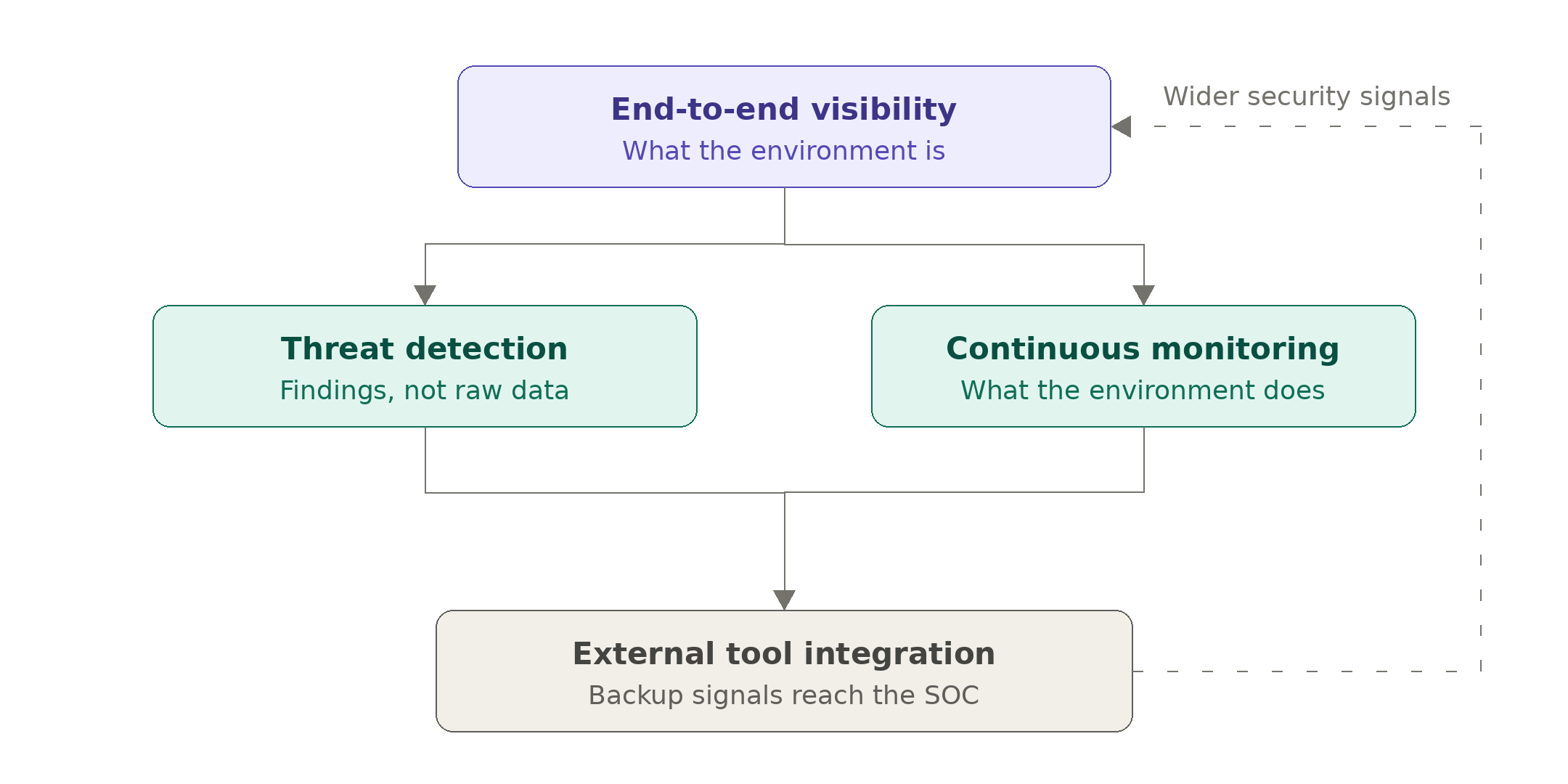
Four dedicated pages, working together in a natural progression: visibility, detection, monitoring, and integration with wider security operations.
End-to-End Visibility
What the environment is. A continuous view of state and coverage across the whole data protection path - source workload to backup infrastructure to repository - revealing what is protected, what isn’t, and how each component is configured. This is what establishes the baseline of “normal” that everything else measures against.
Continuous Activity Monitoring
What the environment does. Watching events as they occur - logins, configuration changes, deletions, job behavior - and flagging those that depart from the established baseline.
Threat Detection
Identifying malware, ransomware, and unauthorized access as early in the attack lifecycle as possible, ideally before it reaches or spreads through backup data. It turns visibility into actionable findings - signatures, indicators of compromise, suspicious file activity - rather than raw data.
External Security Tool Integration
Connecting backup-layer detection and monitoring to the wider security stack (SIEM/SOAR, XDR/EDR), so backup signals reach the people and workflows already responsible for the rest of the environment.